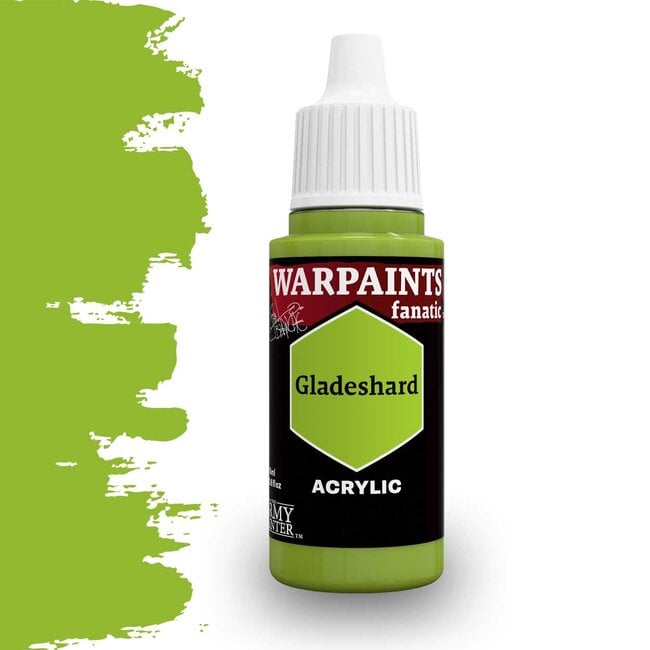
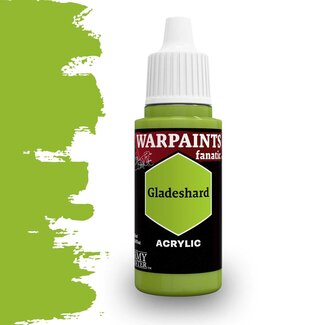
Gladeshard is a vivid yellow-green from The Army Painter's Warpaints Fanatic John Blanche Masterclass range. This 18ml. acrylic originally appeared in John Blanche Masterclass Volume 4 and is ideal for green highlights, goblins, foliage, creatures, toxic effects, magic and striking details within grimdark colour schemes.
What is Gladeshard? Gladeshard is a bright, organic green with a pronounced yellow undertone. It is considerably livelier than a military olive green while retaining enough natural warmth to work across skin, vegetation and weathered fantasy subjects. This allows Gladeshard to function both as a main colour and as a sharp highlight over darker, more subdued greens.
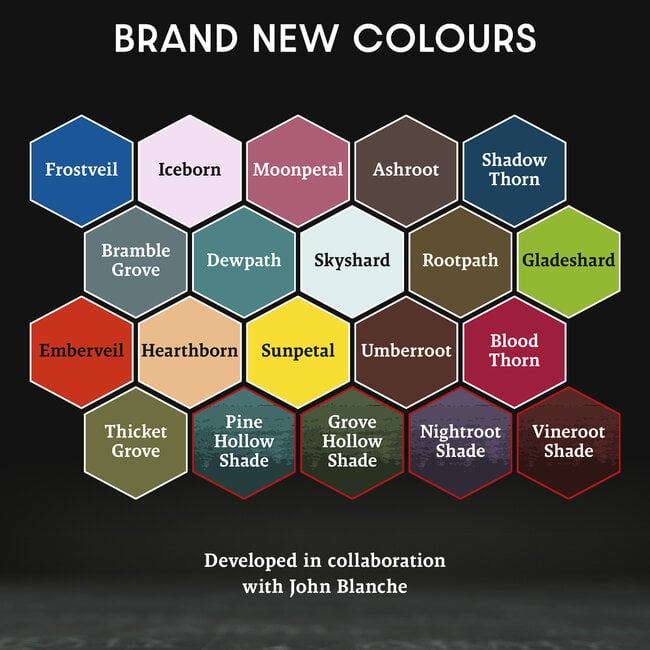
Gladeshard originally appeared as one of the eight acrylic colours in John Blanche Masterclass Volume 4. This volume combines earthy warmth with fiery and striking accents. Developed in collaboration with John Blanche, the colours are designed to support depth, atmosphere and visual storytelling. Within that palette, Gladeshard creates a powerful point of light alongside browns, olive greens, ochres and other weathered colours.
Gladeshard is a conventional Warpaints Fanatic acrylic paint, rather than a wash, Speedpaint, metallic or effect paint. The Fanatic formulation is designed for miniature painting and combines dense pigmentation with a premium resin base and stabilisers. It can be thinned for controlled layers while maintaining good pigment dispersion. This makes Gladeshard useful for basecoating, layering, glazing, blending and precise highlighting.
How do you use Gladeshard? Shake the bottle thoroughly and build the colour with thin layers. For a natural green scheme, begin with a dark olive or forest green and introduce Gladeshard as a lighter midtone or highlight. For much brighter green skin, Gladeshard itself can become the main base colour. Add yellow or warm pale colours to the most raised areas afterwards to increase the sense of volume.
For goblins, orcs and creatures, Gladeshard provides a strong foundation for vivid green skin. One practical workflow is to use Gladeshard as the main colour, followed by increasingly selective highlights mixed with yellow shades such as Sunpetal. A pale warm colour can then be applied to knuckles, noses, cheekbones and other sharp forms. Brown, reddish or purple glazes around the shadows introduce more organic colour variation into the bright green.
Gladeshard is equally useful for foliage and natural terrain. Young leaves, moss, unusual plants, grassy textures and overgrown fantasy ruins all suit its lively character. Use dark olive green in recessed areas and concentrate Gladeshard on surfaces exposed to the light. Stippling several greens and browns alongside one another creates vegetation with more natural variation than a single uniform green surface.
For toxic, radioactive or alien effects, the bright yellow-green becomes particularly effective. Gladeshard can give slime, poison, mutations, alchemical liquids, strange fungi and corrupted growth an unnatural intensity. Build from dark green around the edges towards Gladeshard in the brighter areas, then introduce small yellowish or near-white accents to strengthen the impression of a glow.
Magic and object source lighting also benefit from its high colour intensity. Build a green light source from dark green through Gladeshard and towards yellow-green or a very pale warm tone. Carefully glaze heavily thinned Gladeshard onto nearby surfaces facing the source. Keep this reflected light darker than the source itself so the lighting remains visually convincing.
Across clothing, armour and heraldry, Gladeshard can instead act as a controlled accent colour. A small bright green symbol, edge, shield motif or fabric detail stands out strongly among black, brown, rust and weathered metal. If the green becomes too vivid for the surrounding palette, mix Gladeshard with a subdued olive or apply a thin brown glaze to reduce saturation selectively.
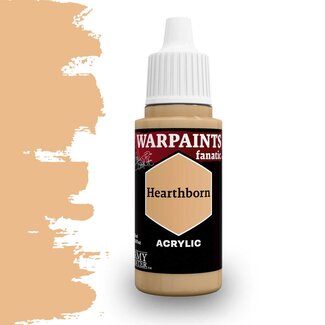
Within Volume 4, Gladeshard combines naturally with Thicket Grove for darker, earthier greens. Sunpetal can progressively make the colour lighter and warmer, while Hearthborn can provide the final pale warm accents. Pairing Gladeshard with Blood Thorn or Emberveil creates much stronger red-green or orange-red-green contrast, useful when a miniature needs a clearly defined focal point.
Gladeshard is suitable for beginners and advanced miniature painters alike. Beginners get a powerful yellow-green that quickly makes skin, vegetation and important details readable. Experienced painters can use it for controlled colour progressions, glazes, lighting effects and strong contrasts. Its main advantage is the combination of brightness and organic character: Gladeshard can be pushed towards vivid fantasy effects while still connecting surprisingly naturally with the earthy colours of a grimdark palette.

Find the order you'd like to withdraw
Enter your email address and order number.
Check your mailbox
If your details match an order, you'll receive an email with a link to view and manage it.