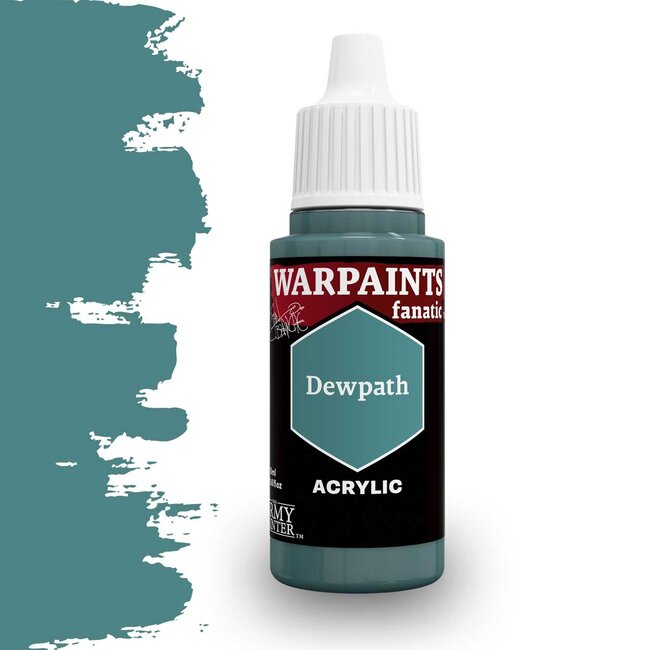
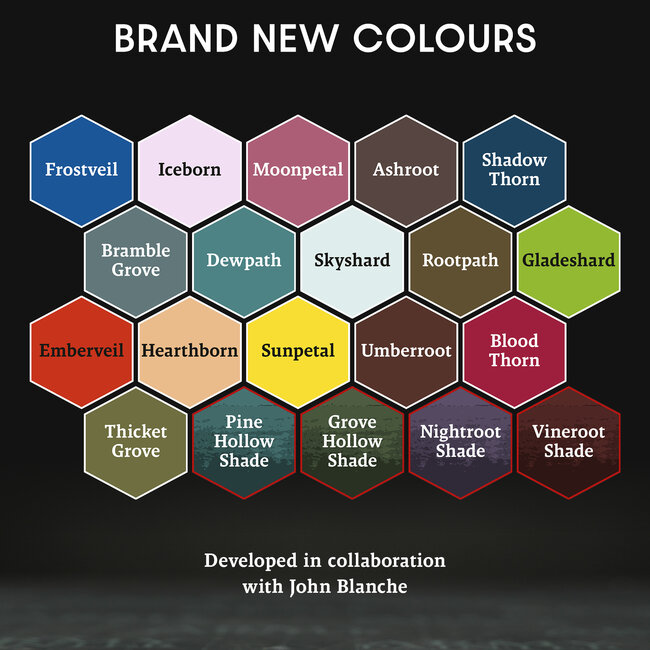
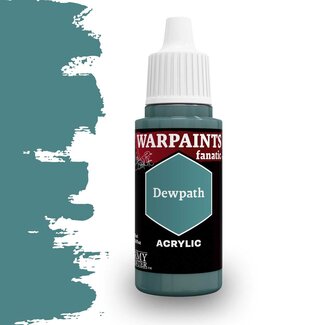
Dewpath is a muted blue-green from The Army Painter's Warpaints Fanatic John Blanche Masterclass range. This 18ml. acrylic originally appeared in John Blanche Masterclass Volume 3 and is ideal for weathered armour, clothing, patina, monsters, magical effects and cold terrain with a mysterious grimdark atmosphere.
What is Dewpath? Dewpath is a cool blue-green that visually sits between turquoise, green and greyed teal. The colour remains clearly visible without the intensity of a highly saturated turquoise. This makes it easy to combine with earthy browns, rust, weathered metal and dark shadows. Within the cold character of Volume 3, it provides a versatile colour for both natural and supernatural subjects.
Dewpath is a conventional Warpaints Fanatic acrylic paint, rather than a wash, Speedpaint, metallic or effect paint. The Fanatic formulation combines dense pigmentation with a premium resin base and stabilisers. This provides strong coverage and smooth brush application. The paint can also be thinned considerably while retaining good pigment dispersion, allowing Dewpath to work as an opaque colour or in controlled layers for blending, layering and glazing.
How do you use Dewpath? Shake the bottle thoroughly and work with several thin layers for an even colour. For a clear blue-green foundation, apply Dewpath directly over a primed surface. For a darker result, begin with deep green, blue or blue-grey and restrict Dewpath to the midtones and raised surfaces. A lighter turquoise, grey-green or ivory can then be used for the sharpest highlights.
On armour, Dewpath works particularly well as a greyed teal colour. Paint complete armour plates or stipple it irregularly over a dark foundation to create a weathered finish. Keep the darker base visible around joints, rivets and damaged areas before introducing dark chips and small metallic accents. Warm rust colours contrast strongly with the cool blue-green and can quickly make old equipment appear more worn and atmospheric.
Dewpath can also be used to paint a patina-like colour accent over copper and bronze surfaces. Thin the paint and place small amounts around rivets, joints, ornamentation and recesses where oxidation would make visual sense. Build the effect locally rather than covering the entire metallic surface in uniform blue-green. Leaving enough of the underlying metallic visible keeps the distinction between metal and discolouration clear.
Across clothing, Dewpath gives cloaks, robes, sashes and weathered uniforms a cold colour that works naturally beside brown leather, bone, dark metal and aged gold. Shade the deepest folds with a darker blue-green and use Dewpath as the main colour. A paler, greyer version on the upper folds quickly creates enough contrast for tabletop miniatures while retaining the subdued character of the palette.
Monsters and unnatural flesh also benefit from this colour. Dewpath works across scales, tentacles, amphibian skin, chitin and strange fantasy creatures. Combine it with dark blue for a cold aquatic result or use subdued greens and earth colours for a more natural creature. A pale highlight makes the scheme more spectral, while violet shadows can push it towards something distinctly alien.
For magic, runes and energy effects, Dewpath can function as a midtone between a dark blue-green foundation and a very pale highlight. Keep the centre of an imaginary light source or rune brightest and allow the surrounding colour to become progressively darker. Heavily thinned Dewpath can also be glazed around the effect to suggest subtle reflected light on nearby surfaces.
Across terrain, Dewpath suits damp stone, weathered walls, statues, ruins, aged doors, fantasy vegetation and cold industrial surfaces. Stipple it irregularly over grey, brown or dark metal and combine it with grime, moss and rust. Used this way, the blue-green becomes part of a layered weathered surface rather than appearing as one perfectly uniform area of colour.
Dewpath is suitable for beginners and advanced miniature painters alike. Beginners get a versatile blue-green that creates distinctive but restrained colour areas quickly. Experienced painters can thin Dewpath for patina, glazes, atmospheric staining and reflected light. This makes it particularly useful whenever conventional turquoise feels too bright and you want a colder, older and more weathered result.

Find the order you'd like to withdraw
Enter your email address and order number.
Check your mailbox
If your details match an order, you'll receive an email with a link to view and manage it.